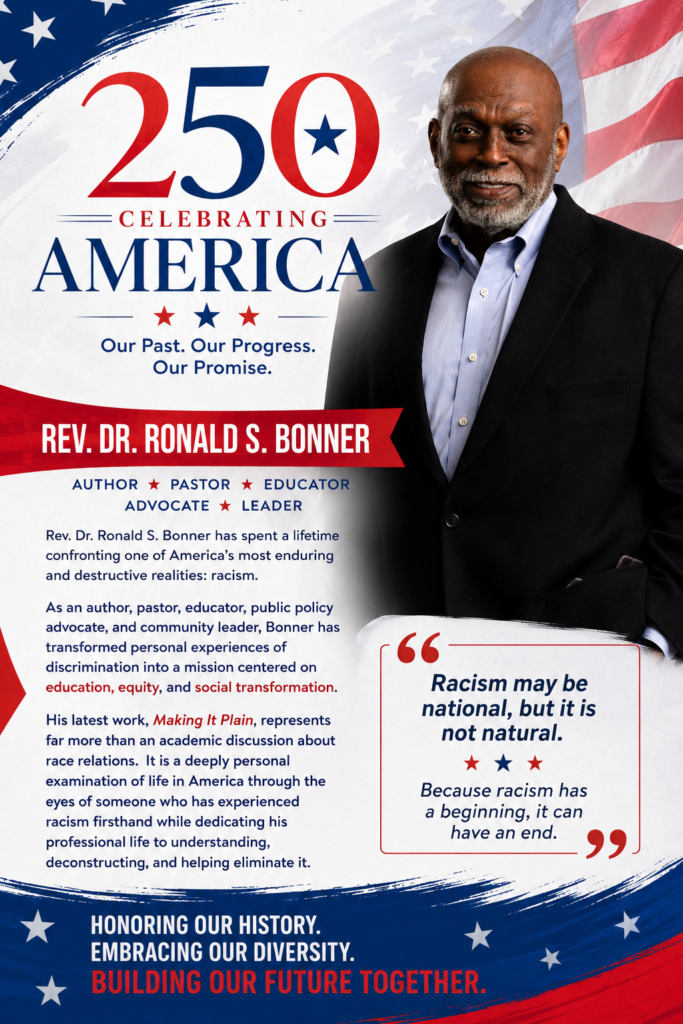
As America prepares to celebrate its 250th anniversary in 2026, the nation finds itself reflecting on both its triumphs and its unfinished work. For Author Rev. Dr. Ronald S. Bonner, Sr., the milestone is not merely a commemoration of independence. It is an opportunity to confront one of the country’s most enduring contradictions: a nation founded on the ideals of liberty and equality while simultaneously permitting systems of racism, exclusion, and inequality to flourish.
Bonner speaks on racism not as an observer from a distance, but as someone whose own life has been shaped by its realities. Over decades, he has witnessed the painful consequences of bigotry and systemic discrimination. From losing a college scholarship to experiencing employment termination and unequal compensation despite superior job performance, Bonner’s journey reflects the experiences of countless Americans of color.
Yet, his response to racism has never been resignation.
“My faith in God has given me the strength to persist against the evils of racism,” says Bonner.
That resilience has guided a life devoted to education, ministry, public leadership, and anti-racism advocacy. Armed with a Doctor of Ministry degree from Candler School of Theology at Emory University, a Master Certificate in Public Leadership from Harvard Kennedy School, and years of practical experience in public policy and organizational leadership, Bonner has become both a student and teacher of racial justice.
His credentials are extensive. He has worked with the Department of Justice to lead anti-racism training for a major hotel chain and served as the former Affirmative Action Officer for the United Church of Christ. But he believes his most important qualification comes from lived experience.
“I have experienced the negative impacts of racism firsthand,” he says. “I also have the educational and professional background to deconstruct racism and help implement solutions that mitigate its harm.”
As America celebrates its semiquincentennial, Bonner believes the nation must resist the temptation to tell only a triumphant story. He argues that the anniversary should also acknowledge the realities of slavery, Jim Crow segregation, caste systems, educational inequities, and the social gaslighting that often minimizes the experiences of marginalized communities.
According to Bonner, racism remains deeply embedded because it continues to serve social, political, and economic interests. He points to scholar David Theo Goldberg’s observation that racism persists because there remains a market for it.
That reality is precisely why education remains central to Bonner’s work.
He argues that racism is neither inevitable nor natural. Instead, it is learned behavior.
This conviction was reinforced during a conversation Bonner had with the late Arthur Fletcher, often called the father of affirmative action, at a conference in Columbus, Ohio, during the late 1990s. Fletcher’s unwavering dedication to racial justice profoundly influenced Bonner’s thinking.
“It was from this conversation that I truly believed in the possibility of a nonracist society,” Bonner recalls.
He also credits historian Howard Zinn’s writings with helping him understand a transformative truth: racism may be national, but it is not natural.
For Bonner, this insight changes everything.
“If racism is learned, it can be unlearned. Because it has a beginning, it can also have an end.”
This philosophy serves as the foundation of his latest work, Making It Plain. The book is both scholarly and deeply personal. It draws upon historical analysis, theological reflection, and personal experience to explore how racism has shaped American society and how individuals and institutions can dismantle it.
Bonner describes the project as more than an academic exercise.
“It is a tale of my life in America as told by me and countless ancestors.”
The book examines difficult concepts, including whiteness, sovereignty, equality, equity, pedagogy, and what Bonner calls “heretical friendship,” relationships that intentionally cross racial and cultural divides in pursuit of justice and understanding. It also explores the psychology behind prejudice, including schadenfreude, the tendency to derive satisfaction from another person’s suffering, which often fuels discriminatory attitudes.
As the nation enters its 250th year, Bonner sees both danger and opportunity.
The danger lies in romanticizing the past while ignoring present inequities. The opportunity lies in choosing education over ignorance, equity over exclusion, and human dignity over division.
For students, clergy, educators, and civic leaders who are weary of living in a society fractured by racism, Bonner offers neither simplistic answers nor despair. Instead, he offers hope grounded in action.
He envisions his work becoming a nationally recognized resource for anti-racism training, teaching, and cultural transformation. More importantly, he hopes to inspire Americans to imagine and create a society where racial justice is not merely an aspiration but a lived reality.
As fireworks illuminate the skies during America’s 250th celebration, Bonner believes the most patriotic act may not be looking backward with pride alone. It may be looking forward with courage.
The question facing America, he says, is not whether racism exists. The question is whether the nation has the collective will to unlearn it.
And for Ronald S. Bonner, the answer begins with one enduring truth: what has been taught can also be untaught, and what has been broken can still be repaired.