









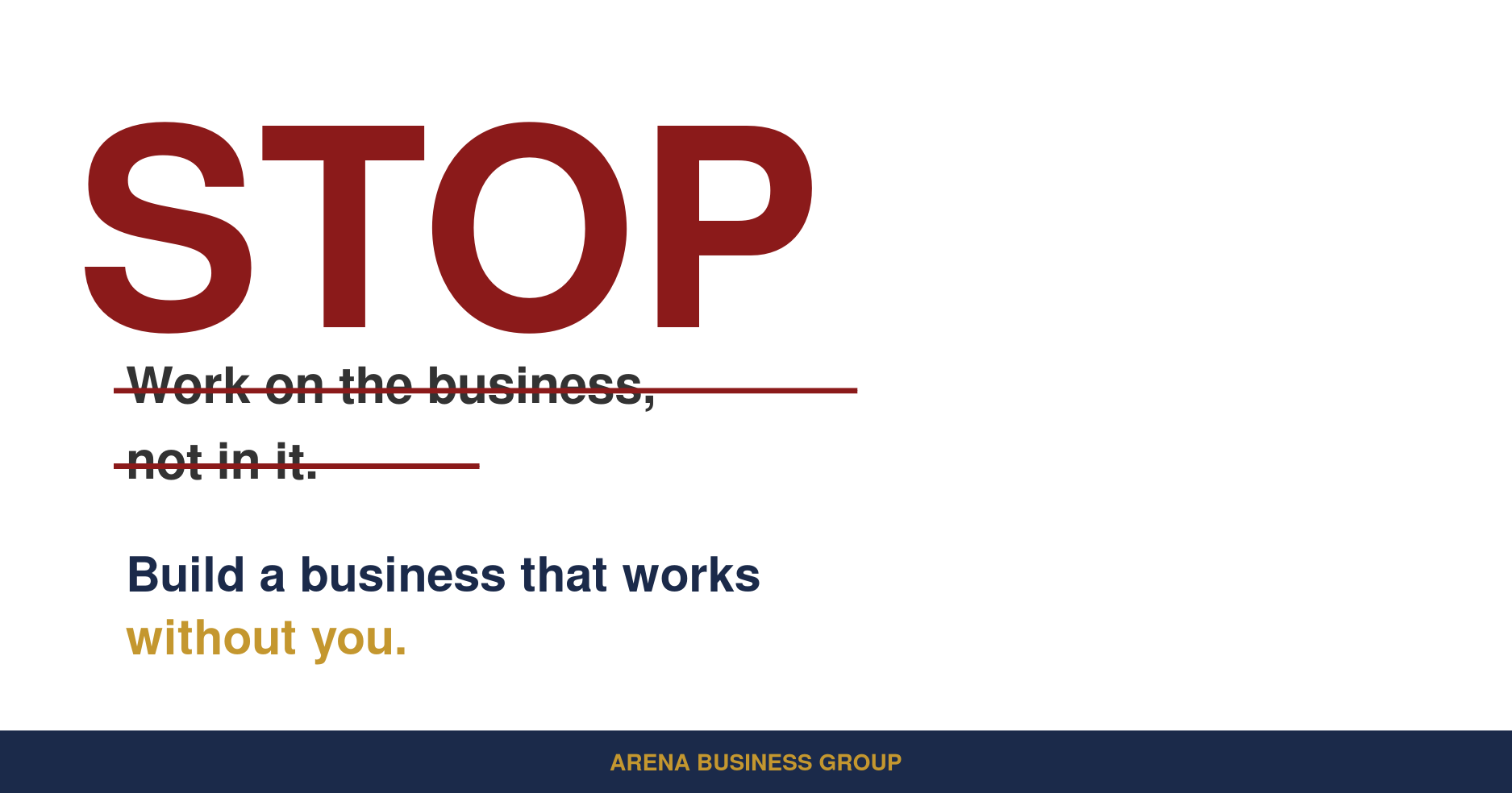
Stop Telling Business Owners to ‘Work ON the Business’
The most repeated advice in entrepreneurship is also the most useless. Here is what to say instead.
Arena Business Group | https://www.arenabusinessadvisors.com/ | February 2026
If you own a business, someone has told you to work on the business, not in it. Probably a hundred times. Probably this week. It is the most repeated piece of advice in the entire entrepreneurship ecosystem, and it is almost completely useless.
Not because it is wrong. The principle is sound. Founders who stay trapped in daily operations cannot build strategic value. Everyone agrees on this. The problem is that the advice has no instructions. It is like telling someone who is drowning to just breathe air. Technically correct. Practically worthless.
Here is what actually happens when a founder hears this advice. They nod. They agree. They feel a brief flash of guilt. Then they go back to doing exactly what they were doing, because nobody told them what working on the business actually looks like on a Tuesday morning at 9 a.m.
Telling a founder to work on the business is like telling someone who is drowning to just breathe air.
Technically correct. Practically worthless.
The advice has become a thought-terminating cliche. It sounds wise. It requires no specifics. And it places the entire burden on the founder to figure out what it means while simultaneously running the operation that pays everyone’s salary.
Arena Business Group has a different take. They do not tell founders to work on the business. They tell founders to build a business that works without them. And then they hand them a blueprint for exactly how to do it.
The distinction matters more than it appears. Working on the business is abstract. Building transferable systems is concrete. It means identifying your ten most critical processes and documenting each one to a standard that a new hire could follow on Day One. It means building a Company Accountability Matrix so every function has a clear owner who is not you. It means climbing what Arena calls the Documentation Staircase, from Level 0, where everything is in your head, to Level 4, where the business runs on systems.
This is not a philosophical shift. It is a mechanical one. And that is exactly why it works. Founders do not need more inspiration. They need a checklist.
The irony of the work on the business mantra is that it was originally coined by Michael Gerber in The E-Myth back in 1986. Gerber’s actual argument was detailed and specific: build systems, create processes, think like a franchisor. But the internet distilled his 200-page book into a seven-word bumper sticker and called it wisdom.
The result is a generation of founders who feel bad about being busy but have no framework for being less busy. They attend masterminds where everyone nods about strategic thinking and then goes home to answer the same emails. The advice creates awareness without agency. It diagnoses without prescribing.
Arena’s framework, which they call the Transferable Method, is the prescription. It breaks the abstract into five concrete phases: Align your team on what matters. Map the workflows. Document them. Automate what you can. Scale what you have built. Each phase has specific deliverables, timelines, and tools.
The founders who go through this process do not describe it as working on the business. They describe it as building a machine. And machines, unlike motivational slogans, actually produce results.
So the next time someone tells you to work on the business, ask them one question: which process should I document first? If they cannot answer that, they are selling a bumper sticker, not a solution.
• •